Fund the need they named.
The Troy School District names special education as the problem this millage would help solve. If it passes, the reasonable thing is to put it there. Here is what Michigan's own data show.
Oakland already leads. This widens the gap.
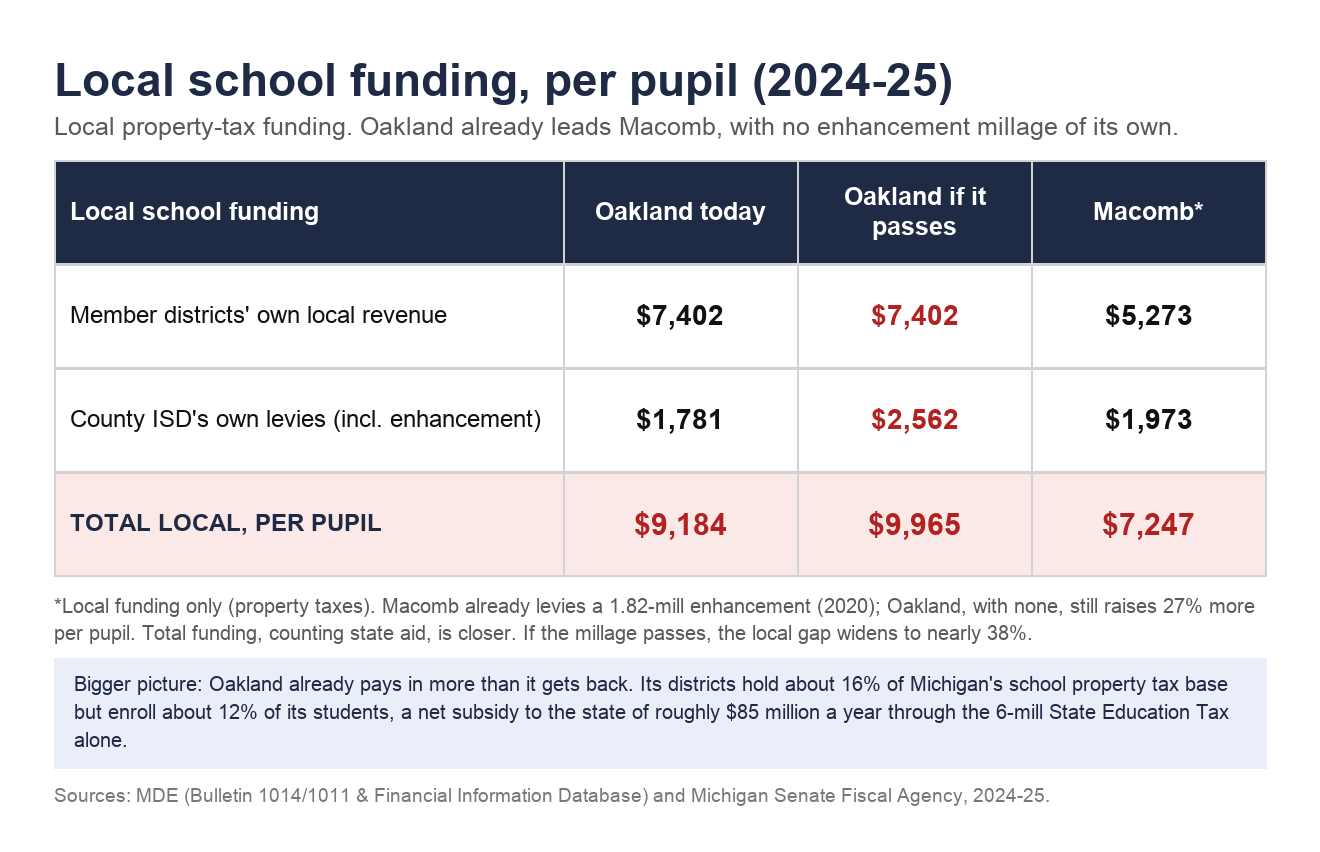
The campaign's headline is that "44% of Michigan students" already receive enhancement funding, implying Oakland is behind. The State of Michigan's own financial data (2024-25) show the opposite. In local funding, Oakland out-raises Macomb, a neighbor that already levies its own enhancement, by 27% per pupil.
| Local funding per pupil, 2024-25 | Oakland today | Oakland if it passes | Macomb* |
|---|---|---|---|
| Member districts' own local revenue | $7,402 | $7,402 | $5,273 |
| County ISD's own levies (incl. any enhancement) | $1,781 | $2,562 | $1,973 |
| Total local, per pupil | $9,184 | $9,965 | $7,247 |
| Total local, per county resident | $1,145 | $1,243 | $887 |
Components are rounded and may not sum exactly to the totals shown; the totals are computed from unrounded figures. *Macomb already levies a 1.82-mill enhancement (since 2020), and Oakland, with no enhancement at all, still raises 27% more per pupil in local funding. Because Oakland's property is worth far more per pupil, its lower 1.5-mill rate is estimated to raise more per student (about $781, the proposal's figure) than Macomb's higher 1.82-mill rate does.
The bigger picture
Oakland is already a net contributor to Michigan's schools
Under Proposal A, the 6-mill State Education Tax and state sales and income taxes are pooled statewide and returned per pupil, so property-rich areas pay in more than they draw back. This does not mean Oakland's own schools are underfunded; it means Oakland already pays more than its share statewide and funds its own schools richly, which is why the "we're behind" framing does not hold. (Oakland school-district taxable value about $77B; statewide taxable value $481.5B; enrollment about 162,000 of 1.38 million. Sources: Michigan Senate Fiscal Agency and Michigan Treasury, 2024; MDE, 2024-25.) Showing the work: Oakland paid $480.6M of the $2.845B statewide State Education Tax in 2024, which is 16.9%, while enrolling about 12% of the state's students. On those figures the gap is nearer $114M a year, so "$85M+" is a deliberately conservative floor rather than a point estimate. Two honest caveats: the School Aid Fund does not hand the State Education Tax back per pupil in equal dollars, because Michigan funds the foundation allowance from local 18-mill revenue first and fills the gap with state aid, which is what Proposal A was built to do; and the State Education Tax is only about 16% of the School Aid Fund, the rest being sales and income tax.
The problem they name vs. the plan they offer
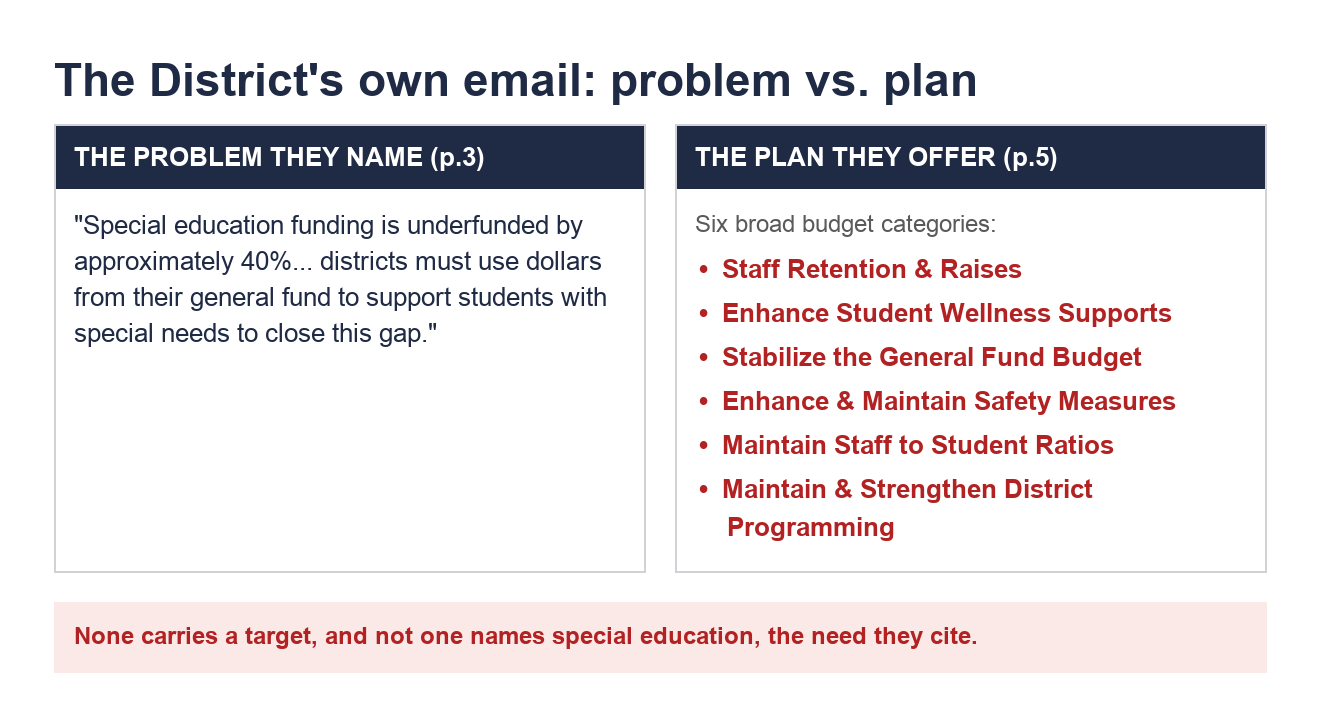
On June 30, 2026, the Troy School District emailed residents in support of the millage. Read closely, it points to what the money should do.
"Special education funding is underfunded by approximately 40%. This means that districts must use dollars from their general fund to support students with special needs to close this gap in funding."
Six broad budget categories, offered as "unrestricted" funds, with no target or reporting attached:
- Staff Retention & Raises
- Enhance Student Wellness Supports
- Stabilize the General Fund Budget
- Enhance & Maintain Safety Measures
- Maintain Staff to Student Ratios
- Maintain & Strengthen District Programming
The email also notes the funds are "unrestricted," and that districts could use them to "increase pay for their teachers," "buy school buses," "hire a school resource officer," and so on: "a variety of uses to support their budgetary goals." All worthwhile uses. None is yet pointed at the special-education gap the District just named.
Read the full text of the District's June 30 newsletter (recipient information removed) so you can check every quote in context. The county-wide campaign's materials are at oaklandenhancementmillage.com.
Special education is a concrete, countable need
The District is right that the gap is real, though its own "40%" figure needs care. When Congress passed the Individuals with Disabilities Education Act (IDEA), it authorized federal funding of up to 40% of the extra cost of educating students with disabilities. That was a ceiling Congress allowed itself, never a promise it made, and regular appropriations have never come close. The remainder falls on local general funds, the same dollars that pay for regular classroom teachers, textbooks, and buses.
Handed the money, not yet pointed at the need
Having named special education, the plan does not yet direct any of the money to it. The six categories are broad and worthwhile, and the funds are "unrestricted," so nothing yet ties them to the special-education gap. Several are things a district can measure, a fund balance or a staffing ratio, which is exactly why it would be straightforward to set a target, commit the dollars, and report the results. That step simply has not been taken yet.
Fund the need they named, and show the results.
This is not an argument that schools cannot use money. It is an argument for spending it where the District itself says the need is, with results voters can verify.
Dedicate 100% to special education
Because the funds are legally unrestricted, each district's board should adopt a public policy committing every dollar to closing its special-education shortfall: the general-fund money it is currently forced to divert.
Publish measurable targets
State the dollars redirected to special education this year, the general-fund dollars thereby freed for classrooms, and service commitments, then report actuals every year through 2031.
Tie the ask to the need
If special education is the reason to tax homes for six years, say so on the record and spend it there, not on an unrestricted "variety of uses."
The money is the answer to the problem they named
If the millage passes, Troy would receive about $9.6 million a year. The District points to federal special-education underfunding (IDEA) as the squeeze on its budget. So the resources to relieve that squeeze would be in hand. It is hard to name the special-education gap as the problem, accept the money, and then not put it toward closing that gap. This is not a knock on the District, which does disclose the cost and makes a fair case that schools are stretched. It is a simple ask: fund the need you named, and show the results.
| What 1.5 mills costs a homeowner | Taxable value | Per year | Over 6 years |
|---|---|---|---|
| Home worth $200,000 | $100,000 | $150 | $900 |
| Home worth $400,000 | $200,000 | $300 | $1,800 |
| Troy 2025 median sale (about $435,000) | $217,500 | $326 | $1,958 |
| Home worth $600,000 | $300,000 | $450 | $2,700 |
The $200,000, $400,000, and $600,000 rows are the District's own examples; the Troy row uses Troy's 2025 median sale price of about $435,000 (Redfin reported $433,750 for December 2025). Taxable value is roughly half of market value, so a rule of thumb is about $75 per year for every $100,000 of a home's value. Homes held a long time under Michigan's assessment cap pay less. An enhancement millage applies to your primary residence, unlike the 18-mill operating tax, which does not.
Run the math yourself
This section makes no argument. It explains the law that governs this millage, then hands you the same figures the State of Michigan publishes so you can check any claim on this page, including ours.
Section 705, in plain English
An enhancement millage is created by MCL 380.705, part of Michigan's Revised School Code. Five things in it decide how the money moves.
The cap is 3 mills. This asks for 1.5.
Half the legal maximum is on the ballot.
"a regional enhancement property tax may be levied by an intermediate school district at a rate not to exceed 3 mills" · §705(1)Up to 20 years, and renewable at any rate up to the cap
This one runs six years, 2026 to 2031. When it expires it can be put to voters again, at 1.5 mills or at anything up to 3. Wayne County shows the pattern: it has renewed twice, each time years before its levy actually ran out.
"may be levied for a term not to exceed 20 years... and may be renewed" · §705(5)You pay by property. You get back by pupil.
This is the whole mechanism. Taxable value appears nowhere in the payout formula, so a district's share of the money depends only on how many children it counts.
"dividing the total amount of the revenue by the combined membership of the constituent districts... and multiplying that quotient by the constituent district's membership" · §705(3)Your homestead is not exempt
The principal residence exemption removes 18 mills of local district operating tax. It does not reach an enhancement millage, which an intermediate district levies under a different section. A homeowner who pays none of the 18 mills pays all of this.
MCL 211.7cc exempts a principal residence only from tax "levied by a local school district... under section 1211"One county-wide vote
Approval is by a majority of all Oakland County school electors, not district by district. A district whose own voters reject it still pays it, and still receives its per-pupil share.
"if approved by a majority of the intermediate school electors voting on the question" · §705(1)Academies count too
Qualifying public school academies are constituent districts for the payout, and for a brand new levy they are in from day one. They hold no taxable property, so they receive without paying. Whether they are in the denominator changes everyone's per-pupil figure.
a qualifying academy "is considered to be a single constituent district" · §705(7)| District | Pupils | Taxable value | Pays | Receives | Net |
|---|
A district is a net donor when its share of the county's taxable value is bigger than its share of the county's pupils, and a net receiver when it is smaller. Changing the millage rate scales every figure up or down together, so it never changes who is which. Only enrollment does that.
Where these numbers come from, and how to re-run them
- Both columns come from one state file: the Michigan Department of Education's Bulletin 1014 export for 2024-25.
AVG FTEis the fall pupil count a district is paid on;HSEV + NHSEVis the ad valorem taxable value it is taxed on. Despite the legacy column names, Bulletin 1014's own glossary defines those as taxable value "as reported on the DS4410", not SEV. - Vintage. These are 2024-25 taxable values. The ballot estimates the 2026 levy at $125,756,247, which implies a base about 9% higher, i.e. two years of growth. Because growth lifts what a district pays and what it receives together, it does not change anyone's donor or receiver status.
- Why the per-pupil figure moves. The campaign's $781 implies 161,020 pupils, which matches Oakland's 28 traditional districts. Counting the 24 academies and their 16,163 students, as §705(7) and the ballot language provide for, gives about $707. Toggle the checkbox above to see both.
- Check it yourself. The scripts that produced this table are in the repository:
tools/net_position.pyandtools/enrollment_trend.py. They download the state files themselves and recompute from scratch, and they cross-check the result against MDE's own published per-pupil columns, against the certified ballot estimate, and against a second independent enrollment source.
The last time Oakland County voted a school tax for special education
This page asks the District to commit the millage to special education and report the results. That is not an abstract worry. Twenty-five years ago, Oakland County voters approved a tax for special education, and a good deal of it went into an office building while children waited for services. Here is what happened, from the reporting at the time.
A special election almost nobody voted in
Oakland Schools, the county's intermediate district, put special-education and vocational-education millage increases to voters in a standalone special election. Fewer than 8% of registered voters turned out. Running the election by itself cost about $300,000. Critics called it a stealth election.
Mackinac Center for Public Policy, "Eliminate Intermediate School Districts," Oct. 6, 2003The money helped pay for a headquarters
Oakland Schools built a new administration building on Pontiac Lake Road in Waterford, across the street from the offices it already had. Its own board hired a forensic accounting firm, the Whall Group, to examine the district's finances. Investigators found, in the Free Press's words, "lax billing practices and the use of special education money to help fund a new $29.5-million building and a technology project." The Mackinac Center later put the special-education share at $18 million of the total; that figure appears in no other source we could find, so treat it as one organisation's estimate rather than an established fact.
Detroit Free Press, "Board fires Oakland's school chief," Lori Higgins, Feb. 1, 2003; The Oakland Press, Jan. 11, 2003; Mackinac Center, Oct. 6, 2003How it was done, from a witness under oath
The clearest account of the mechanism is not in any newspaper. It is in the trial record. Bill Lee, the district's plant and facilities consultant, testified that an assistant superintendent, at the superintendent's behest, asked him to recalculate how much of the new administration building's square footage could be attributed to special education by counting common areas, corridors, meeting rooms and storage. Lee's testimony about the purpose is quoted in the federal court's opinion:
"make sure that they were getting the maximum amount from special ed as far as being able to charge them in square footage-wise"Testimony of Bill Lee, Trial Transcript, Jan. 20, 2005, at 99, quoted in Redmond v. Worthington, No. 07-15152 (E.D. Mich.)
That is the whole thing in one sentence: not a bookkeeping error, but a deliberate effort to maximise how much of an office building could be billed to special education.
What the Free Press found
A Free Press investigation into Oakland Schools' spending documented administrators' travel, meals and gifts: $3,548 in airfare for a trip to Germany and France, $3,295 for a San Diego trip, $730 on Palm organizers, $405 on custom-wrapped candy, $545 on a single retreat meal. One sentence in that story is the reason this section exists.
"While school officials spent freely, some special-needs students were put on waiting lists for services."Detroit Free Press, "School Bosses in Oakland Wine, Dine and Live it up on Taxpayers' Dime," L.L. Brasier, Aug. 22, 2003
The superintendent was fired
The board fired Superintendent James Redmond, who had led the district since 1995. Among the grounds: arranging 15 employee buyouts totalling more than $680,000 without the board's knowledge, and using $450 of professional-development money, in the board's phrase, "for his own purposes and pleasure," on flying lessons.
Detroit Free Press, Feb. 1, 2003; The Oakland Press, "Redmond stripped of duties," Diana Dillaber Murray, Jan. 11, 2003Charged, convicted, and acquitted
On March 29, 2004, Attorney General Mike Cox charged Redmond with felony embezzlement and misconduct in office. An Oakland County jury convicted him of misconduct in office and of a conflict-of-interest offence covering contracts between a public servant and their own public body, and acquitted him of embezzlement. The conduct proven at trial was self-dealing: he chaired the board of the MINDS Institute while signing district contracts with it, and the district paid it more than $500,000. He was sentenced to six months in jail and three years' probation. The conviction was affirmed on appeal, the Michigan Supreme Court declined to hear it, and a federal habeas petition was denied in 2012.
Two things this does not mean. The criminal case was about the MINDS Institute self-dealing, not about the building; the forensic report on the building's funding did not describe his actions as criminal, and no charge was ever brought over it. And Redmond remained free on bond throughout his appeals; we found no record confirming he served the six months.
Education Week, Ann Bradley, Feb. 9, 2005; People v. Redmond, No. 261458, 2006 WL 3298360 (Mich. Ct. App., Nov. 14, 2006), leave denied, 480 Mich. 883 (2007); Redmond v. Worthington, No. 07-15152 (E.D. Mich., July 17, 2012)The law changed, and it changed because of this
State Rep. Ruth Johnson of Holly, whose district was in Oakland County, chaired a House subcommittee that was granted subpoena power. The seven-bill package that followed did not die. All of it passed, as Public Acts 412 through 419 of 2004.
Read the title of Johnson's own bill and you can see the building in it. House Bill 5839 became 2004 PA 415: "uses for special education and vocational education bond proceeds and millages; clarify and limit duration of certain intermediate school district millages." It restricts what an intermediate district may do with money raised for special education, and requires a pro-rata split where a facility only partly serves those programs. It is, in plain terms, a law against doing what had just been done.
Its companion, 2004 PA 412, created MCL 380.622a, which for the first time subjected intermediate districts to independent audits directed by the Department of Treasury. The list of things those audits must examine reads like a table of contents for the preceding two years: adherence to travel guidelines, administrator compensation, non-competitively-bid contract modifications, FOIA compliance, misuse of public funds, and "proper expenditure of tax levies for vocational-technical and special education purposes."
MIRS, Apr. 15, 2003; HB 5839 (2004 PA 415, approved Nov. 29, 2004); HB 5457 (2004 PA 412, adding MCL 380.622a, eff. July 1, 2006); Michigan House Legislative Analysis of the packageA note on the sourcing, because it matters here. The spine of this account is the court record: the Michigan Court of Appeals opinion and the federal habeas opinion, both public, both quoting sworn testimony. That is deliberate. The contemporaneous Free Press, Oakland Press and MIRS reporting survives online only as reprints on a parent-advocacy site, the Detroit News originals sitting behind a paywall; the text is internally consistent and matches the court record, but a reprint is not an original and we are not going to pretend otherwise. Where accounts differ we say so: the building's cost is variously given as $29 million, $29.5 million and $30 million, apparently reporting drift as construction went on, and the $18 million special-education share is the Mackinac Center's figure alone. James Redmond left office more than twenty years ago; this section is about an institution's record and a statute's origin, not about a person.
Sources & method
Data, definitions, and sources
- District communication: Troy School District, "Oakland County Enhancement Millage Proposal," email newsletter, June 30, 2026. All quotations and the six spending tiles are from that email; the full text is reproduced here (recipient information removed). County-wide campaign materials: oaklandenhancementmillage.com.
- Local revenue & membership: Michigan Department of Education Bulletin 1014 and 1011 (2024-25) and the state Financial Information Database (Revenue Data, 2024-25). Oakland member-district local revenue totals reconcile exactly to the MDE Bulletin 1011 export. Macomb ISD enhancement (1.8198 mills levied in 2025, 2020-2029) per Macomb Intermediate School District. MISD's audited financial statements for the year ended June 30, 2024 report $66,430,519 levied, and state that "in 2024-2025, over $70 million will be levied." Correction, July 2026: an earlier version said "about $55M+ per year," which was the 2020 first-year ballot estimate and understated the current levy by roughly 20%. Population from the U.S. Census, 2024.
- Special-education funding: IDEA's 40% maximum authorized share and the FY2025 federal share of about 10.2% of national average per-pupil expenditure, per the Congressional Research Service (R44624, "IDEA Funding: A Primer", updated Feb. 2026). Michigan's 86% actual coverage of approved special-education costs and the $616.8M remaining shortfall (FY2023-24), plus the 28.6138% Durant constitutional floor, per the Michigan House Fiscal Agency, "Fiscal Brief: Special Education Funding" (Feb. 25, 2026). Context from the Michigan League for Public Policy ("Michigan Special Education Funding 101," May 2024) and the Autism Alliance of Michigan. Correction, July 2026: an earlier version of this page cited the MEA's "Facts v. Fallacy: School Funding" for these figures. That article does not discuss special education; the attribution was wrong and has been replaced with the primary sources above. The earlier "$350M to $750M" range came from 2023 Autism Alliance testimony and has been replaced with the Fiscal Agency's published current figure.
- Proposal terms: 1.5 mills for six years (2026-2031), about $781 per pupil per year, collected beginning December 2026, distributed to all public districts and eligible academies on a per-pupil basis; the ISD keeps none. Sources: oaklandenhancementmillage.com, Oakland County Times and Detroit News (March 25, 2026).
- "Local funding" vs. "spending": "local funding" is each entity's own local sources (property tax plus other local), governmental funds, excluding state and federal aid and excluding ISD-to-district pass-through, to avoid double counting. It is not total spending: total per-pupil operating funding, adding state and federal aid, is about $17,100 in Oakland and about $16,100 in Macomb (MDE Financial Information Database, 2024-25). Per-pupil figures use fall membership; the enhancement is shown at the campaign's own $781 per pupil figure. Troy home values from Redfin (median sale price $433,750, December 2025); Zillow's ZHVI, a value index rather than a sale price, reads about $442,000.
- OC history (2001-2005): the Sept. 25, 2001 special/vocational education millage and its under-8% turnout, and the $18M-of-$29M building figure, per the Mackinac Center for Public Policy, "Eliminate Intermediate School Districts" (Jack McHugh and Brennan Brown, Oct. 6, 2003). The forensic finding of "lax billing practices and the use of special education money to help fund a new $29.5-million building," the firing of Superintendent James Redmond, the 15 buyouts totalling over $680,000 and the $450 in flying lessons, per the Detroit Free Press, "Board fires Oakland's school chief" (Lori Higgins, Feb. 1, 2003). The spending detail and the waiting-list quotation, per the Detroit Free Press, "School Bosses in Oakland Wine, Dine and Live it up on Taxpayers' Dime" (L.L. Brasier, Aug. 22, 2003). The conviction for misconduct in office and conflict of interest, and the acquittal on embezzlement, per Education Week (Ann Bradley, Feb. 9, 2005) and People v. Redmond, No. 261458 (Mich. Ct. App., Nov. 14, 2006), leave denied 480 Mich. 883 (2007). The legislative response per MIRS (Apr. 15, 2003) and the Michigan House Legislative Analysis of HB 5457 and companions (complete to Sept. 8, 2004); we found no public act number for any of them. Distribution mechanics of an enhancement millage per MCL 380.705.